


pharma Tag

USP General Chapter <41> Balances establishes the requirements for balances used for materials that are to be accurately weighed. Weighing must be done with a balance that is calibrated over the operating range and meets the defined requirements for Repeatability and Accuracy.

This proposal is based on the official version dated August 1, 2019. The proposal published in PF 49(5) [September-October 2023], has been cancelled and is being replaced by this new one.

The proposed changes gather comments received from stakeholders and are intended to align with Weighing on an Analytical Balance 〈1251〉 as well as the European Pharmacopoeia chapter “Balances for Analytical Purposes”.

In addition to formal changes, updates and additions were made in the following areas:

  1. Introduce the relationship between calibration and performance checks within the life cycle approach to ensure fitness for purpose.
  2. Include the concept of a risk-based approach with respect to the frequency of calibration and performance checks.
  3. Add a new section on Calibration, clarifying its purpose and including considerations for uncertainty and frequency.
  4. Introduce clarifications of compliance with respect to the Repeatability
  5. Align the term minimum weightwith that in 〈1251〉 and in the European Pharmacopoeia, with regard to standard deviation. Include calculation examples.
  6. Introduce text that differentiates the minimum weightfrom the smallest net weight.
  7. Clarify criteria to ensure compliance with the required accuracy during performance test checks and calibration, including consideration of the uncertainty of the test weights.
  8. Incorporate additional applicable references into the text.

Comments and observations on these drafts can be submitted until 30 November 2024.


USP General Chapter 1251 Weighing on an Analytical Balance is a guideline applicable to balances used in all analytical procedures. It provides information on installation and operational qualification (IQ/OQ), performance qualification and balance checks (routine testing), minimum weight, and balance operation.

This proposal is based on the version of the official chapter issued on May 1, 2018. The previous proposal, published in PF 49(5) [September-October 2023], has been cancelled and is being replaced by this new draft. Based on comments received from stakeholders and to align with Balances 〈41〉 as well as the European Pharmacopoeia chapter “Balances”, the following changes are proposed:

  1. In the Introduction, clarify the group of instruments in which balances are included as per Analytical Instrument Qualification 〈1058〉 and its relationship with the analytical target profile described in Analytical Procedure Life Cycle 〈1220〉.
  2. Add a new section, Principle, defining weight and units.
  3. In Performance Qualification, the risk of the weighing application is explained with regard to the user’s quality management system in order to define the frequency and the type of performance qualification activities.
  4. Discuss the frequency of each of the individual tests included, as well as the relationship between calibration and verification.
  5. Delete the section Balance Checks and integrate it into Performance Qualification.
  6. Simplify the definition of minimum weight and add clarifications about the tare vessel as well as examples to address frequently asked questions.
  7. Introduce a safety factor that addresses critical performance changes of the balance during routine usage.
  8. Add a Glossary to clarify the use of specific terms.
  9. Add Additional Information to ensure alignment of concepts and terminology.


SOURCES:

Pharmacopeial Forum (PF) | USP-NF (uspnf.com)

The draft document “Data Integrity for In Vivo Bioavailability and Bioequivalence Studies” was published on the US FDA website at the beginning of April 2024. The document aims to assist applicants and marketing authorisation holders on achieving and maintaining data integrity for the clinical and bioanalytical part of bioavailability (BA) and bioequivalence (BE) studies for INDs (investigational new drug applications) submission, NDAs (new drug applications), ANDAs (abbreviated new drug applications), for the bioanalytical part of the clinical studies of BLAs (biologic licence applications) as well as for supplements and amendments to these marketing authorisations.

In addition, the recommendations in this guidance apply to the bioanalytical portion of nonclinical studies. The FDA also encourages applicants and testing sites to take these recommendations into consideration when conducting in vitro, pharmacology and toxicology studies.


SOURCES:

https://www.fda.gov/media/177404/download

The draft guidance document “Handling and Retention of Bioavailability and Bioequivalence Testing Samples” is being distributed at March 2024

The guidance is intended to provide recommendations for study sponsors and/or drug manufacturers, contract research organizations (CROs), site management organizations (SMOs), clinical investigators, and independent third parties regarding the procedure for handling reserve samples from relevant bioavailability (BA) and bioequivalence (BE) studies, as required by 21 CFR 320.38 and 320.63.

The guidance highlights

  1. how the test article and reference standard for BA and BE studies should be distributed to the testing facilities,
  2. how testing facilities should randomly select samples for testing and material to maintain as reserve samples,
  3. how the reserve samples should be retained
  4. addresses the requirement at 21 CFR 320.38 (c) to retain sufficient quantity of reserve samples to allow FDA to perform five times all the release tests required in an application or supplemental application
  5. describes the conditions under which the Agency does not generally intend to take enforcement action against an applicant or CRO for retaining less than the quantity of reserve samples of the test article and reference standard that were used in the BA or BE study as specified in 21 CFR 320.38(c)

The guidance also clarifies the points addressed in §§ 320.38 and 320.63.


SOURCES:

https://www.fda.gov/media/71393/download

The Reflection Paper discusses methodological aspects of non-interventional studies (NIS) using real-world data (RWD) to generate real-world evidence (RWE) for regulatory purposes.

The draft document on the use of real-world data in NIS to generate RWE is open for comment until 31 August 2024.

While clinical trials are the main source of evidence for the assessment of benefits and risks of medicinal products in marketing authorization procedures (they generally use randomisation, blinding, and a controlled environment), NIS are so far more accepted in post-authorization safety assessments.

Their use to assess the efficacy of medicinal products is hampered by methodological restrictions, such as the absence of randomisation, uncontrolled conditions, non-standardised treatments and uncertainties about data quality and completeness.

The reflection paper provides some examples where NIS using RWD have supported regulatory decision-making processes.

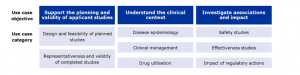
  • To perform post marketing monitoring, investigate safety concerns and evaluate the effectiveness of risk minimisation measures.
  • To describe patterns of drug utilisation.
  • To characterise disease epidemiology.
  • To validate outcome measures.
  • To support the feasibility assessments and the planning of non-interventional post authorisation safety, efficacy and medicinal products utilisation studies.
  • To compare patient characteristics of the study population to those of the clinical practice population in the real-world.
  • To understand the clinical context, by describing standards of care, variability in clinical practices and unmet medical needs.


Conclusions

Non-interventional studies play an increasing role in the generation of evidence to define and complete the totality of the evidence required for novel vaccines and treatments as well as label extension for existing therapies.

The wide variety in research objectives, study designs, data and methods present a challenge for standardisation; on the other hand, the regulatory authorities evaluating the evidence generated from NIS and the different stakeholder groups have different expectations regarding their use and fitness for purpose.

It is important to continue the effort to achieve a shared approach.


SOURCES:

https://www.ema.europa.eu/en/reflection-paper-use-real-world-data-non-interventional-studies-generate-real-world-evidence-scientific-guideline

  • The use of Real-World Data (RWD) is increasingly embedded in the scientific evaluation of human medicines.The newly published EMA document on the topic (Guidance on Real-world evidence provided by EMA), explains:
    • how RWE, derived from analysis of RWD, can be useful in the context of regulatory decision-making,
    • what types of studies can be conducted,
    • how the EMA can help identify the best resources to address a research question.


    An analysis of the RWD provided by the EMA could help

    • to fill knowledge gaps;
    • to provide independent and transparent RWE sources;
    • to carry out specific analyses tailored to the individual case, e.g. to support the work of EMA’s scientific committees;
    • generate evidence more quickly, shortening the process steps that an MAH would have to comply with to obtain the corresponding study approved;
    • avoid unnecessary duplication and inefficiency that might be typical of studies done by industry.

    An overview of the three main areas in which RWE can support regulatory decision-making is shown in the figure below (taken from the document).

  • SOURCES:

    EMA’s Big data website.

  • The ICH Q3C(R9) “Guideline for Residual Solvents” was revised using the ICH Minor Revision Procedure and reached Step 4 of the ICH Process on 24 January 2024.The document adopts a minor revision to section 3.4. concerning the consideration of solvent volatility for analytical methods.

    The Q3C ICH Guideline was finalised under Step 4 in July 1997 and provides recommendations on using of less toxic solvents in the manufacture of drug substances and dosage forms, as well as setting pharmaceutical limits for residual solvents (organic volatile impurities) in drug products.

    As part of the maintenance process, the Q3C Guideline incorporated the revision and inclusion of new Permitted Daily Exposure (PDE) levels as new toxicological data for solvents became available.

    In section 3.4 the guideline states that: “If only Class 3 solvents are present, a non-specific method such as loss on drying may be used, if the method is properly validated. The impact of solvent volatility on the test method should be considered in the validation.

    Validation of methods for residual solvents should conform to the current version of ICH guideline Q2 on Validation of Analytical Procedures”.

    SOURCES:

    ICH: News

  • FDA has published the draft guidance “Conducting Remote Regulatory Assessments Questions and Answers Draft Guidance for Industry” to describe the Agency’s current thinking on the use of remote regulatory assessments (RRAs). FDA has used RRAs to conduct surveillance, reduce risk, meet critical public health needs, and help maximize compliance of FDA-regulated products. This draft guidance provides answers to frequently asked questions about what RRAs are, when and why FDA may use them, and how FDA may conduct them, among others.

    The term “RRA”, as defined in the Question and Answers section, include activities for which the FDA may use different terminologies, such as “remote interactive evaluations” and “remote record reviews“. RRAs were mainly used to support submissions or applications assessments of FDA-regulated products and to reduce delays.

    In the presence of travel restrictions during the COVID-19 pandemic, FDA utilized RRAs to assess establishments and their compliance with applicable FDA requirements.

    Based on this experience, FDA has noted the value of RRAs and concluded that, under certain circumstances, they should be retained for some scenarios outside the COVID-19 pandemic for all types of FDA-regulated products.

    The Agency is also issuing this guidance to promote greater consistency in the way RRAs are conducted, explaining the processes for responding to an RRA request and outlining the factors to consider in assessing whether an establishment has responded timely and appropriately to a mandatory request.

    SOURCES:

    https://www.fda.gov/media/160173/download

  • on January 6, 2024, the Indian Ministry of Health notified the revision of GMP rules in accordance with Schedule M of the Drug and Cosmetic Regulation, with the aim of ensuring robust quality control for pharmaceutical and biopharmaceutical products.

    With this revision, the emphasis is placed on enhancing and updating the existing GMP framework to align with the global standards and international expectations, in particular those of the World Health Organization (WHO). The review was also driven by the rapid evolution of the manufacturing and quality domain and the need to keep pace with the latest technological advances.

    With the amendment, the term ‘Good Manufacturing Practices’ (GMP) has been replaced with “Good Manufacturing Practices and Requirements of Premises, Plant and Equipment for Pharmaceutical Products”.

    Some of the major changes introduced in the revised Schedule M include the introduction of a pharmaceutical quality system (PQS), quality risk management (QRM), product quality review (PQR), qualification and validation of equipment, and a computerised storage system for all drug products.

    The revised Schedule M has 13 parts which provide GMP guidelines for the specific requirements for manufacturing pharmaceutical drugs and also include five new categories of drugs that were not previously covered under the rules.

    The new categories include pharmaceutical products containing hazardous substances such as sex hormones, steroids (anabolic and androgenic), cytotoxic substances, biological products, radiopharmaceuticals, phytopharmaceuticals, and investigational pharmaceutical products for clinical trials for humans.

    The manufacturer must assume responsibility for the quality of pharmaceutical products to ensure that they are fit for their intended use, comply with the requirements of the licence, and do not place patients at risk due to inadequate safety, quality, or efficacy. The manufacturer must also market a finished product only after getting satisfactory results from tests of the ingredients and retain enough samples of intermediate and final products to allow repeated testing or verification of a batch.” [Health Ministry notifies revised Pharma manufacturing rules under schedule M to ensure quality control – The Hindu].

    SOURCES:

    https://www.thehindu.com/

The U.S. Food and Drug Administration (FDA) has organized a stakeholder call to discuss the DSCSA implementation, which took place on 29 November 2023.

The Drug Supply Chain Security Act (DSCSA) drug supply chain security requirements, ten years after its implementation, are intended to improve the FDA’s ability to detect and remove potentially dangerous drugs, whether: counterfeit, stolen, contaminated or otherwise, from the supply chain.

Among the topics covered:

  • 10-year anniversary of DSCSA implementation
  • Stabilization period and expectations for trading partners to achieve interoperable, electronic tracing of products at the package level
  • Recent key guidances for industry related to supply chain security requirements
  • Looking ahead

Also in late November, the FDA announced that the CDER NextGen Portal (CDER NextGen) includes a DSCSA portal that enables the FDA and trading partners to communicate when the FDA requests information related to investigations of suspect or illegitimate products or during a recall.

The DSCA portal is used to:

  • Confirm basic information and points of contact for trading partners
  • Notify trading partners when they have messages from the FDA
  • Enable trading partners to respond to FDA messages and upload documents

Additionally, the DSCSA enables to:

On October 31st, the Swiss Medicines Inspectorate published a technical interpretation of GMP Annex 1. The interpretation focuses on some of the most significant changes of the revision 2022 of Annex 1 “Manufacture of Sterile Medicinal Products”. It also addresses aspects that were already included in the previous guideline version and have consistently prompted questions.

It should be noted that the document references the revised Annex 1 of the PIC/S GMP Guideline (PE 009) about the manufacture of sterile medicinal products. This was adopted on 9 September 2022 by the PIC/S Committee and came into force on 25 August 2023 (with the exception of point 8.123, which will become binding from 25 August 2024).


Contents of the document

The document consists of a list of questions regarding chapters of Annex 1 and the corresponding answers as interpreted by SwissMedic.

It includes the following sections:


  1. Purpose and scope
  2. Basics
  3. Definitions and abbreviations
  4. Interpretation: Questions and Answers

4.1     Scope (Annex 1, Chapter 1)

4.2     Premises (Annex 1, Chapter 4)

4.3     Utilities (Annex 1, Chapter 6)

4.4     Personnel/Training (Annex 1, Chapter 7)

4.5     Production and Specific Technologies (Annex 1, Chapter 8)

4.6     Environmental & Process monitoring (Annex 1, Chapter 9)

4.7     Quality Control (QC) (Annex 1, Chapter 10)

  1. Changes to the previous version


Some questions aim to provide further clarification on the language used in the document, but there are also several inquiries regarding the assessments of single-use systems (SUS).

The document contains a total of forty-six questions and their corresponding answers.


SOURCES:

Interpretation of GMP Annex 1 2022 (Rev. 1).